What Are the Top Types of Precision Bearings?
Precision bearings are built for controlled motion, tight tolerances, and predictable performance. Yet “precision” does not mean one bearing fits every machine. A spindle turning at high speed faces different demands from a robot joint carrying changing loads or a pump exposed to vibration. Small details matter: shaft fit, lubrication, operating temperature, and alignment can all shape bearing life.
Bearing analyst Tedric A. Harris, author of Rolling Bearing Analysis, offers a useful principle through his technical work: select a bearing for its real operating conditions, not just its catalog rating. This is a paraphrased takeaway, not a verbatim quotation. It sounds obvious. It is often overlooked. A bearing that handles heavy radial loads may not suit a design that needs axial stiffness or quiet, high-speed rotation.
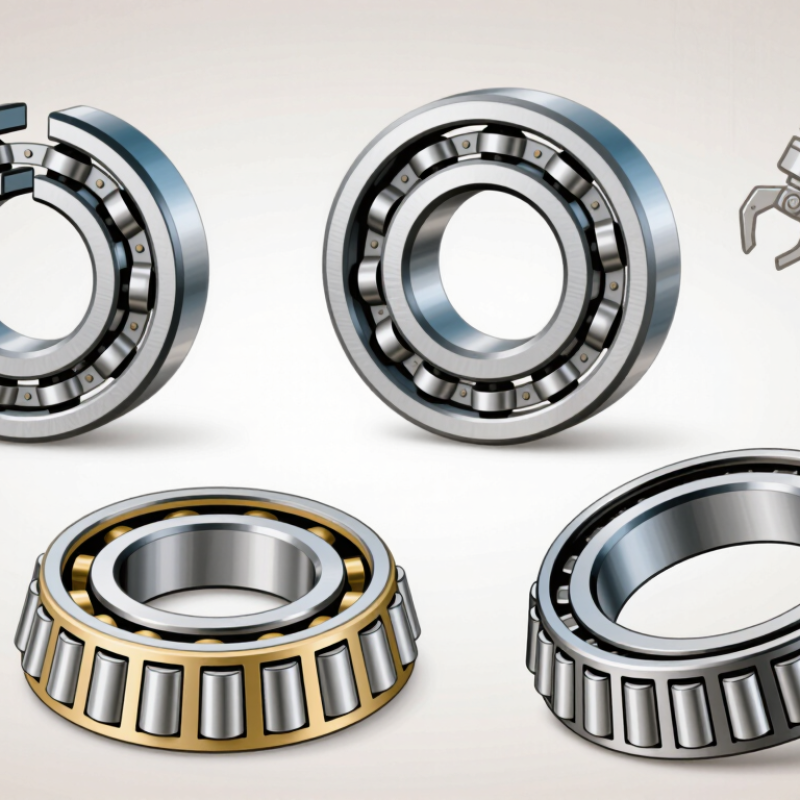
This guide introduces the top types of precision bearings, including angular contact, deep groove ball, cylindrical roller, tapered roller, and thrust bearings. Each type has distinct strengths, limits, and typical uses. We will compare how they manage loads, speed, rigidity, and installation demands, with practical examples from machine tools and industrial equipment. No type is universally best. Even a carefully chosen bearing can disappoint when mounting or lubrication is wrong, so selection deserves a second look.
Precision Bearing Accuracy Classes in ISO 492: P0, P6, P5, P4, and P2
ISO 492:2023 classifies precision bearing accuracy as P0, P6, P5, P4, and P2. P0 is the standard class; tolerances become tighter toward P2. The standard specifies dimensional and running-accuracy tolerances, with limits depending on bearing type and size. So “P4” alone does not give every allowable deviation.
That difference matters in a spindle. A tighter class can help control runout and vibration, but it cannot correct a misaligned housing or poor shaft fit. In practice, installation, preload, lubrication, and operating speed also affect system accuracy. Precision has limits. ISO 492 provides the tolerance framework, not a promise of machine performance. Buyers should compare the bearing’s specified dimensions and measured runout with the assembly requirements, rather than choosing the highest class by habit.
Tips: Match the class to the job. For general machinery, P0 or P6 may be sufficient; high-speed spindles often call for P5 or tighter, subject to design checks. Confirm the exact tolerance values in ISO 492:2023 and the bearing drawing. A tighter class can add cost without improving results when the surrounding parts remain less accurate.
ISO 492 Precision Bearing Accuracy Classes
The classes are ordered from standard accuracy to higher precision: P0, P6, P5, P4, and P2. The chart’s 1–5 scale is an ordinal ranking only—not an ISO tolerance value. Actual tolerances depend on bearing type and dimensions.
Angular-Contact Ball Bearings: Common Contact Angles of 15°–40°
What Are the Top Types of Precision Bearings?
Angular-Contact Ball Bearings: Common Contact Angles of 15°–40°
Angular-contact ball bearings support radial loads and axial loads, but their capacity depends partly on contact angle. Common angles range from 15° to 40°. The angle describes how the ball transfers force between the inner and outer raceways. A 15° design often suits high-speed spindles with moderate axial loading. Larger angles, such as 25° or 40°, can support greater axial loads, though speed capability may be lower. These are useful tendencies, not guarantees; bearing design and operating conditions matter.
Single-row bearings typically support axial force in one direction. For loads from both directions, engineers often arrange two bearings as a matched pair. Back-to-back or face-to-face mounting changes how the pair handles moment loads and misalignment. Preload can reduce shaft movement, but excessive preload may increase heat. I’ve seen the details matter: a small mounting error can undermine an otherwise suitable bearing.
Tips: Check the manufacturer’s load and speed ratings, then confirm lubrication, fit, and preload for the actual application. Look for early heat or vibration during testing. Small clues count. A contact angle alone cannot select a bearing, and that limitation is easy to overlook.
What Are the Top Types of Precision Bearings? - Angular-Contact Ball Bearings: Common Contact Angles of 15°–40°
| Contact Angle |
Typical Characteristics |
Axial Load Capability |
Common Applications |
Key Considerations |
| 15° |
Low contact angle; often selected for high-speed precision applications. |
Lower axial-load capacity than bearings with larger contact angles; supports axial load in one direction when used as a single-row bearing. |
High-speed machine-tool spindles and precision rotating equipment. |
Usually requires a suitably arranged second bearing to support axial loads in both directions. |
| 25° |
Intermediate angle offering a balance between speed capability and axial-load support. |
Moderate axial-load capacity; a single-row bearing supports axial load in one direction. |
Machine-tool spindles, pumps, and general precision machinery. |
Performance depends on bearing arrangement, preload, lubrication, and operating speed. |
| 30° |
Common general-purpose angle that provides increased axial support compared with smaller angles. |
Moderate to relatively high axial-load capacity for a given bearing size. |
Industrial gear drives, pumps, compressors, and precision machinery. |
Often used in paired arrangements when axial loads may act in either direction. |
| 40° |
Large contact angle, prioritizing axial-load support over the highest speed capability. |
Relatively high axial-load capacity; a single-row bearing supports axial load in one direction. |
Applications with substantial axial loading, including some pump and gearbox arrangements. |
Check the manufacturer’s speed limits and mounting guidance, as a larger angle can affect operating speed and heat generation. |
Note: Contact angle is measured between the line joining the ball-to-raceway contact points and a plane perpendicular to the bearing axis. Actual load and speed limits depend on bearing design, size, clearance or preload, lubrication, and mounting arrangement.
Deep-Groove Ball Bearings: Radial Loads and Limited Axial Loads
Deep-groove ball bearings are designed mainly to carry radial loads, which act perpendicular to the shaft. Their continuous, deep raceway grooves also let them handle limited axial loads in either direction. This makes them useful in electric motors, small pumps, and conveyor rollers, where a shaft may experience both forces. The axial capacity is not unlimited. It depends on bearing size, internal clearance, lubrication, speed, and how the bearing is mounted.
A practical example is a motor shaft carrying a pulley. The belt pulls sideways, creating a radial load, while slight movement along the shaft can create an axial load. A deep-groove bearing may manage both when those forces stay within its rated limits. Check the load ratings and operating speed rather than relying on appearance. A bearing that feels smooth by hand can still be unsuitable at high speed or under continuous load. Small details matter.
Listen for a changing hum. Check for excess heat, vibration, or unusual shaft movement, but treat these as clues, not a diagnosis. Poor alignment or excessive preload can shorten service life, even when the bearing type seems right. “Limited axial load” can be easy to overlook. It deserves a careful review against the actual operating conditions.
Cylindrical-Roller Bearings: N, NU, NJ, and NUP Configurations
Cylindrical-roller bearings carry substantial radial loads through long rollers that contact the raceways across a broad area. Their separable rings can also make mounting and inspection easier. The N, NU, NJ, and NUP designations describe flange arrangements, which determine how the bearing handles axial movement. That detail matters.
An N bearing has two flanges on its inner ring and none on its outer ring, allowing axial displacement in either direction. An NU bearing reverses that arrangement: two outer-ring flanges and no inner-ring flanges. Both designs can accommodate shaft movement relative to the housing. An NJ bearing has two outer-ring flanges and one inner-ring flange, so it can locate a shaft axially in one direction. NUP adds a separate loose flange beside the inner ring’s single integral flange, allowing location in both directions.
The distinction can seem fussy on a drawing; in a warm machine, it can affect how expansion is managed. For example, an NU bearing may suit a position where the shaft must move axially, while an NUP may help hold a shaft in place. Actual selection depends on the full arrangement, loads, fits, and operating conditions. No suffix replaces checking those details. One overlooked fit can still cause trouble.
Tapered-Roller Bearings: ISO 355 Series for Combined Loads
Tapered-roller bearings use conical rollers and matching raceways to carry radial and axial loads together. The ISO 355 series defines metric boundary dimensions and bearing series, helping designers compare suitable sizes. It does not, by itself, guarantee performance in a particular machine. Load ratings, speed limits, lubrication, and operating conditions still need review.
Axial capacity acts mainly in one direction, so applications with thrust from both directions often use a matched pair or another locating arrangement. For example, a gearbox shaft may experience radial force from gear teeth and axial force from helical gears. Correct adjustment matters: excessive preload can raise temperature, while excessive clearance may allow shaft movement. Small details count. Installation alignment and clean lubricant also influence service life. A catalog dimension can look right and still lead to a poor fit; checking the actual load path and housing tolerances is worth the extra effort. I would not treat the ISO series designation as a complete selection guide. It narrows the options, but operating data must finish the decision.


' d='M0 0h21v15H0z'/%3E%3Cpath fill='url(%23b)' d='M0 0h21v5H0z'/%3E%3Cpath fill='url(%23c)' d='M0 5h21v5H0z'/%3E%3Cpath fill='url(%23d)' d='M0 10h21v5H0z'/%3E%3C/g%3E%3C/svg%3E)